
How Does Jellyfil Work? The Five Ingredient Groups
Jellyfil is a daily gummy built on an 82 mg blend in five ingredient groups.
The groups are L-arginine for nitric oxide, desire herbs, ashwagandha for stress, tribulus with horny goat weed, and 5 mg of caffeine. It is a daily supplement, not an on-demand pill.
Next, see how to take it each day.
How does Jellyfil work, in plain terms?
A daily blend, not a drug and not an on-demand pill.
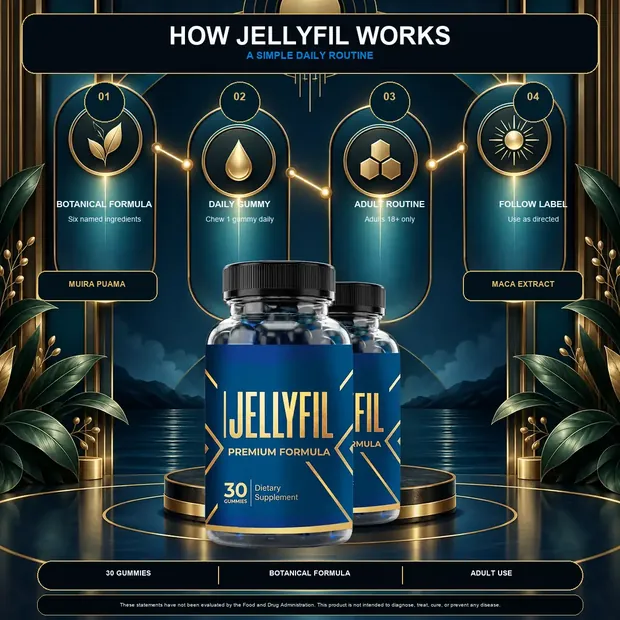
Jellyfil is built on a simple idea. One gummy a day delivers a small mix of plants and one amino acid that have been linked, in tradition or in studies, to blood flow, desire, stress and energy.
The brand's sales page frames this as support for libido, circulation, stamina and confidence. Those are its words, not proven results. Here is the honest version of how the formula is meant to work, group by group.
- 1
One gummy a day
The label says to take 1 gummy once daily.
- 2
Five ingredient groups
Nine ingredients share one 82 mg blend.
- 3
Steady daily use
Herbs are usually judged over weeks, not hours.
- 4
Honest check-in
Track how you feel at day 30 and day 60.
The five ingredient groups in the Jellyfil formula
Nine ingredients, five jobs, one small blend.
The nine ingredients fall into five groups. Each group has a different intended role. The table shows what each group is meant to do and how strong the human evidence is today.
Jellyfil ingredient groups at a glance
| Group | Ingredients | Intended role | Human evidence |
|---|---|---|---|
| Blood-flow building block | L-arginine | Raw material for nitric oxide | Moderate, at 1.5–5 g a day |
| Desire herbs | Maca, muira puama, catuaba | Traditional libido support | Limited to very limited |
| Stress herb | Ashwagandha | Stress, sleep and vigor | Small trials, mixed results |
| Traditional 'male' herbs | Tribulus, horny goat weed | Folk use for vitality | Weak; no rise in testosterone |
| Alertness | Green tea extract, caffeine 5 mg | A light lift in alertness | Clear for caffeine, but 5 mg is tiny |
Each ingredient has its own page. Start with the Jellyfil ingredients overview or read the full Supplement Facts label.
L-arginine in Jellyfil: the circulation idea
A real mechanism, studied at grams, not milligrams.
L-arginine is an amino acid. Your body uses it to make nitric oxide, a gas that signals blood vessel walls to relax. Relaxed vessels let blood flow more easily, and healthy blood flow matters for sexual health.
This is the best-studied ingredient in the blend. A 2019 review found arginine helped mild to moderate ED compared with placebo, at 1.5 to 5 grams a day (Rhim et al., 2019). Desire scores did not change.
The catch is the amount. Even if the whole 82 mg blend were arginine, it would be about 1.6% to 5.5% of the studied range. Arginine can also lower blood pressure (MSK About Herbs, Arginine, 2022). See the L-arginine page for details.
Ready to try Jellyfil?
Best value$49 a bottle · $294 for 6
Maca, muira puama and catuaba: Jellyfil's desire herbs
Long tradition, short evidence.
These three come from South America and have long folk use for desire and vitality. They are the heart of the 'libido' message on the sales page.
Maca has the most research of the three, and it is still thin. A review of small trials found only 'limited evidence' for sexual function, at about 1.5 to 3 grams a day (Shin et al., 2010). Muira puama alone has no quality clinical trials (Drugs.com, Muira puama, 2026). Catuaba's human evidence is limited, and many products sold as catuaba did not contain the labeled plant (WebMD, Catuaba, 2026).
Ashwagandha in Jellyfil: the stress and sleep angle
A calm-and-rest herb with mixed results for vigor.
Stress, poor sleep and fatigue can all dampen desire. Ashwagandha is an herb used for stress, and that is its likely role in the formula.
In one 8-week trial of 57 men, testosterone rose more than with placebo, but fatigue, vigor and sexual well-being did not differ from placebo (Lopresti et al., 2019). Trials for stress used about 225 to 1,250 mg a day (NIH ODS Ashwagandha, 2025). The amount in Jellyfil is not published and sits inside the 82 mg blend.
Ashwagandha has rare liver and thyroid reports. Read the ashwagandha page before you start.
Tribulus and horny goat weed: popular, but weak evidence
Folk favorites that do not hold up well in trials.
These two herbs are common in men's formulas. Their reputation is bigger than their research.
A review found tribulus did not raise testosterone in humans when used alone (Qureshi et al., 2014). Horny goat weed has no human trials for sexual function (MSKCC Epimedium, 2023). Its active compound, icariin, is not listed on the label. That is why this site does not repeat the 'healthy testosterone' line from a brand graphic.
Editorial view of human evidence per ingredient (not a test of Jellyfil)
Green tea extract and 5 mg of caffeine in Jellyfil
A tiny dose of a familiar stimulant.
The label lists caffeine at 5 mg, the only amount it prints. Green tea extract may add a little more, but its amount is not given.
For scale, a 16-ounce cup of tea has about 60 to 100 mg of caffeine (MedlinePlus, Caffeine in the diet, 2025). So 5 mg is roughly a few sips. It is small, but it is a stimulant, so this site does not call Jellyfil 'stimulant-free'.
If you are sensitive to caffeine, take the gummy in the morning. The how to use page covers timing.
Start your 60-day window today
Best value$49 a bottle · $294 for 6
How much of each ingredient is in a Jellyfil gummy?
One printed total, one printed amount, eight unknowns.
The label shows one total: an 82 mg proprietary blend. Only caffeine has its own number. The rest share the remaining 77 mg in a split the brand does not publish.
The label also says the blend equals 'approximately 567 mg of dry powders.' That describes the raw plant material used to make the extracts, about 7 to 1 on average. It does not mean the gummy holds 567 mg of extract.
Even 567 mg would be less than the low end of one studied maca dose. In short, the doses are a small fraction of what research used.
Is Jellyfil like Viagra or Cialis?
A daily wellness gummy, not an ED medicine.
No. Prescription ED pills such as sildenafil and tadalafil are PDE5 inhibitors. They block an enzyme so blood flow lasts longer when a man is aroused, and a doctor prescribes them (NIDDK, Treatment for ED, 2024). Jellyfil contains no drug and does not work this way.
ED can also be an early sign of heart disease, diabetes or high blood pressure (NIDDK, Symptoms & Causes of ED, 2024). If erections are a problem, see a doctor first. Our guide on when to see a doctor explains why.
Has the Jellyfil formula been studied?
Ingredient research, yes. Product research, no.
No published study has tested Jellyfil itself. The research above looked at single ingredients, mostly at much higher doses.
The FTC says studies on one ingredient may not support claims about a finished product unless the dose and formula match (FTC Health Products Compliance Guidance, 2022). The FDA does not approve supplements before sale (FDA Supplements Q&A, 2026).
- Full ingredient list printed on the labelShown
- Caffeine amount printed (5 mg)Shown
- Amount of each other ingredientNot published
- A clinical study of Jellyfil itselfNot published
- Independent lab certificate, including hidden-drug testingNot published
What you can do is try it with clear eyes, track how you feel, and use the 60-day money-back window if it is not for you.
Jellyfil how-it-works questions
How does Jellyfil work?
Jellyfil is meant to work through a daily mix of nine plant and amino-acid ingredients, taken as 1 gummy a day. Each group has a traditional or studied role, such as blood flow, desire, stress or alertness. The whole blend is 82 mg, and no study has tested this formula, so any effect is unproven.
Does Jellyfil work like Viagra or Cialis?
No. Viagra and Cialis are prescription PDE5 inhibitor drugs that act on a specific enzyme. Jellyfil is a dietary supplement with no drug in it and no proven effect on erections. If you want an ED medicine, talk with a doctor.
What is in Jellyfil gummies?
Each gummy lists an 82 mg proprietary blend of muira puama, maca, catuaba, green tea extract, caffeine (5 mg), ashwagandha, L-arginine, tribulus and horny goat weed. It also has 3 g of added sugar from corn syrup and cane sugar.
How much of each ingredient is in Jellyfil?
The label does not say, except for caffeine at 5 mg. Split evenly, 82 mg across nine ingredients is about 9 mg each. The real split is not published.
Does Jellyfil increase testosterone?
There is no evidence that it does. The label has no testosterone figure, and tribulus did not raise testosterone in human trials. If you think your testosterone is low, a doctor can test it with two early-morning blood draws.
Does L-arginine increase nitric oxide?
Yes, the body uses L-arginine to make nitric oxide, which helps blood vessels relax. ED studies used 1.5 to 5 grams a day, far more than the whole 82 mg blend in one gummy.
Is Jellyfil science-backed?
Some of its ingredients have been studied, mostly at gram doses. Jellyfil itself has no published study. Ingredient research does not prove that a different dose or a mixed formula works.
How long does Jellyfil take to work?
No timeline is published or guaranteed. Most herb studies ran several weeks, so judge it over a month or more. The money-back window is 60 days from purchase, after at least 30 days of use.
Is Jellyfil FDA approved?
No. The FDA does not approve dietary supplements before they are sold. The label says it is produced in a GMP facility, which is a manufacturing standard, not an approval.
Ready to try Jellyfil?
Order from the U.S. authorized merchant, keep your order email, and you are covered by the 60-day money-back guarantee. Questions first? Call +1 (507) 448-8190.
- Secure checkout
- 60-day money-back window
- Ships from the US
- Tracking by email
Keep reading
Ingredients
All nine blend ingredients, the gummy base and how 82 mg compares with research doses.
Read more →Benefits
The four sales-page claims, the evidence behind each, and what the gummy cannot do.
Read more →Side effects
Stomach, caffeine, blood pressure, liver, thyroid, interactions and hidden-drug risk.
Read more →