
Reading the Jellyfil Label: A Shopper's Guide to Supplement Facts
The Jellyfil panel shows a serving of one gummy, 30 servings, 10 calories, 3 g of added sugar, 4 mg of sodium and an 82 mg proprietary blend of nine ingredients. Only caffeine, at 5 mg, gets its own number. The bottle makes no benefit claim, and the split of the other eight stays secret.
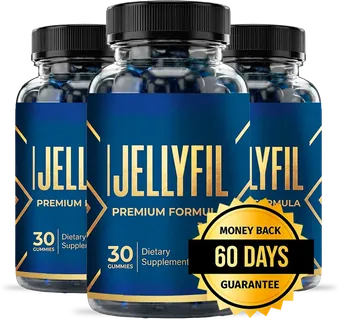
Want to compare the label with the offer?
The order page lists each pack and the 60-day terms, so you can check them against your own bottle later.
Disclosure: this site earns money when you order through it.
Key facts
- Serving size is one gummy a day, and a container holds 30 servings.
- Each gummy brings 10 calories, 3 g of carbohydrate (all of it added sugar) and 4 mg of sodium.
- The Proprietary Blend weighs 82 mg, and caffeine at 5 mg is the lone figure printed inside it.
- A footnote ties the blend to about 567 mg of dry powders. That number describes the plant used, not the gummy.
- A warning line sends pregnant or nursing women, anyone on medication and anyone with a medical condition to a doctor first.
- Left off the label: how the other eight ingredients divide the blend, the amount of sorbitol and the factory name.
What does the front of the Jellyfil bottle say?
The front is brief: Jellyfil, Premium Formula, 30 Gummies, Dietary Supplement. The last phrase is a legal category and not a promise. It says the product is sold as a supplement rather than a drug.
Nothing on the front promises a benefit. Words like libido, stamina and confidence live on the sales page, not on the bottle. When an ad and a bottle disagree, believe the bottle.
Here is a habit worth adopting: read the Supplement Facts panel before the front. The front is marketing space. The panel is regulated space.
How do you read the Jellyfil Supplement Facts panel line by line?
Every figure on the panel is for one gummy. DV means Daily Value, a yardstick built on a 2,000-calorie diet, and herbal blends have no DV.
Jellyfil Supplement Facts per gummy, with a plain note on each line
| Panel line | Label says | What it means |
|---|---|---|
| Serving size | 1 gummy | The unit behind every number that follows |
| Servings per container | 30 | A bottle runs 30 days at the label dose |
| Calories | 10 | Nearly all from sugar |
| Total carbohydrate | 3 g (1% DV) | Counts the sugars and the sorbitol |
| Total sugar | 3 g, includes 3 g added (6% DV) | No natural sugar; it is all added |
| Sodium | 4 mg (under 1% DV) | A trace that comes from sodium citrate |
| Proprietary Blend | 82 mg (DV not established) | The nine ingredients taken together |
| Caffeine | 5 mg, inside the blend | The sole ingredient with a figure of its own |
In label order, the nine names inside the blend are muira puama extract, maca extract, catuaba extract, green tea extract, caffeine, ashwagandha, L-arginine, tribulus terrestris and horny goat weed extract.
What does proprietary blend mean on the Jellyfil label?
The maker prints the combined weight of a group of ingredients and keeps each weight private. Here the group weighs 82 mg. Caffeine is pulled out at 5 mg, and the other eight share the remaining 77 mg.
Divided evenly, each of the eight gets about 9.6 mg. Real blends are seldom even, so read that as a sense of scale and not a fact. The brand does not publish the split.
Why care? Studies of these ingredients dosed in grams, not milligrams. L-arginine trials gave 1.5 to 5 g a day (Rhim et al., 2019), and maca studies began near 1.5 g (Shin et al., 2010). Without the split, a reader cannot set one gummy beside those doses.
What does about 567 mg of dry powders mean on the label?
Per the footnote, the 82 mg blend stands in for roughly 567 mg of dried plant powder. That tells you how the extracts were made. A maker soaks dried plant, draws off the liquid and dries the remainder, which weighs far less than the plant it started as.
Start with dried plant
Roughly 567 mg of dried bark, root and leaf powder, spread across the blend.
Extract and dry
Water or alcohol draws out compounds, and the liquid is dried into a concentrate.
Weigh the result
The material that goes into the gummy totals 82 mg.
Read it right
Your gummy contains 82 mg of blend. It does not contain 567 mg.
The ratio comes to roughly 7 to 1. It shows how concentrated an extract is. It cannot show which compounds made it through.
What is in the Jellyfil gummy besides the blend?
Everything else in the gummy is corn syrup, cane sugar, water, apple pectin, sorbitol liquid, natural flavors, citric acid and sodium citrate dihydrate. Pectin makes the gummy set. Citric acid and sodium citrate tune the sourness.
Sugar is the figure to watch if you count carbs. Three grams a gummy equals about 8% of the 36 g daily added-sugar ceiling that the American Heart Association suggests for men (AHA, How Much Sugar Is Too Much?, 2026). It is small, yet a bottle adds up to 90 g across a month.
Sorbitol is a sugar alcohol whose amount is not printed. A laxative warning is demanded only where daily intake could hit 50 g (21 CFR 184.1835 (sorbitol)), and a gummy holds just 3 g of carbohydrate overall. A sensitive stomach may settle if you eat the gummy with breakfast.
What do the warning, storage and missing lines tell you?
The warning sends pregnant or nursing women, people on medication and people with a medical condition to a doctor before use, and tells everyone to stop and call a doctor after any bad reaction. For storage, keep the bottle between 59 and 86°F, shut tight, away from children, with the cap seal unbroken.
- Serving, servings, calories, sugar and sodiumPrinted
- Blend total (82 mg) and caffeine (5 mg)Printed
- Suggested use, warning, storage, distributorPrinted
- Weights of the other eight blend ingredientsNot published
- Sorbitol per gummyNot published
- Factory name and independent lab certificateNot published
Treat the reference lot JEL-26/JE-2187 and CoA JEL-2187-26-JE as tracking labels. They are not lab proof.
What do the Daily Value percentages on the panel mean?
Percent Daily Value shows how much of a day's reference amount one serving supplies, based on a 2,000-calorie diet. Jellyfil's panel prints 1% DV for 3 g of total carbohydrate, 6% DV for 3 g of added sugar and under 1% DV for 4 mg of sodium.
The blend has no percentage, because none exists for herbal blends. So the percentages speak about sugar and sodium and say nothing about the herbs.
A second yardstick gives a slightly different number. The American Heart Association suggests men stay under 36 g of added sugar a day (AHA, How Much Sugar Is Too Much?, 2026), and 3 g is about 8% of that. Both yardsticks tell the same story: a gummy is a small sugar load, and a bottle adds 90 g over a month.
Frequently asked questions
What is the serving size of Jellyfil?
One gummy. The directions say one gummy once daily, or as a qualified health care professional advises, and a bottle holds 30 servings.
What does proprietary blend 82 mg mean on Jellyfil?
It means nine ingredients together weigh 82 mg in each gummy. Caffeine, at 5 mg, is the only one with a figure of its own, and the other eight are not broken out.
How many calories are in a Jellyfil gummy?
Ten, nearly all from the 3 g of added sugar. A whole bottle comes to about 300 calories across the month.
Does the Jellyfil label list any health claims?
No. The bottle makes none. The four claims belong to the sales page and come with the FDA note that they have not been evaluated.
Does Jellyfil contain sorbitol?
Yes, sorbitol liquid is on the other-ingredients list, though no amount is given. With only 3 g of carbohydrate per gummy, the sorbitol must be small.
Where can I see the full Jellyfil label?
On your own bottle, and on the Supplement Facts page of this site, which walks through it line by line. Compare the two before your first gummy.
Our view
The Jellyfil label is clear about what it prints and quiet about what it leaves out. We prefer that to vague claims, but the quiet is the story. One amount out of nine cannot tell you the dose.
If you keep one habit from this guide, make it reading the panel first and the front second. Check the serving, the blend total, the caffeine and the sugar, then ask what is missing.
No number here makes Jellyfil good or bad. Together they describe a small, sweet, lightly caffeinated gummy. Whether that suits you is a matter for you and your doctor.
Reminder: Jellyfil is not FDA approved, and no dietary supplement is. It is not intended to diagnose, treat, cure, or prevent any disease. Anyone with a medical concern, including erection trouble, should see a doctor.
Read first, then order
Once the label makes sense to you and your medicines are checked, the order page shows the packs and the guarantee.
Disclosure: this site earns money when you order through it.
Supplement facts
The Supplement Facts panel line by line, plus sugar, caffeine and 30-day math.
Read more →Ingredients
All nine blend ingredients, the gummy base and how 82 mg compares with research doses.
Read more →Testing & quality
The GMP line, why no supplement is FDA approved, what the seals mean and quality questions to ask.
Read more →